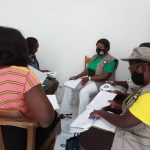
Preparations for a historic NPRC Conflict Mapping Baseline Survey are currently underway. NPRC is currently engaging stakeholders to gather views that will inform the forthcoming survey. This week,three organisations have been engaged. These are NANGO, National Association of Youth Organisations (NAYO) and Women’s Coalition of Zimbabwe. Views are gathered on conflicts during the Precolonial Period, Colonial period, 1884 Berlin Conference to 1930 period, Early African Resistance period (1931 to 1950s), Second Chimurenga Struggles ( 1950s to 1979) and the Post Independence period.
Thursday, November 26, 2020
0 Comment
|
Wednesday, November 25, 2020
0 Comment
|
The National Peace and Reconciliation Commission invites all PRAZ and UNDP registered companies to make a firm offer for the provision of the following services: –
- ICT Accessories and Equipment
- Motor Vehicle Maintenance
Download the RFQs from the links below for more information.
Wednesday, November 25, 2020
0 Comment
|
The National Peace and Reconciliation Commission invites all registered companies to make a firm offer for the provision of the following services: –
- Office Provisions (Mineral Water, Drinks, Sugar, etc)
- Office Stationery (Bond paper, Cartridges etc)
Download the copies of the RFQs from the links below
Tuesday, November 17, 2020
0 Comment
|
The National Peace and Reconciliation Commission invites all registered companies to make a firm offer for the provision of the following services:-
- Branded Cameraman Jackets
- Temporary Name Tags (IDs)
For more information download the REQUEST FOR QUOTATION document.
Monday, October 26, 2020
0 Comment
|
The National Peace and Reconciliation Commission (NPRC) is structured along thematic areas
which inform the programs undertaken in 2019. These are Research and Knowledge Management;
Complaints Handling and Investigations; Healing, Reconciliation and Rehabilitation; Victim
Support Gender and Diversity, and Prevention and Non-Recurrence with support departments
namely Finance, Administration and Human Resources; Media and Communications; Legal
Services; Audit, Information, Communication and Technology and Monitoring and Evaluation.
The activities conducted under each of the programs in the reporting year are outlined in the report;
suffice to note that the work was aimed at achieving the strategic outcomes of; enabled processes
and frameworks for addressing legacies of violent conflicts through inclusive healing efforts; a
positive and legal environment for peace; improved architecture for conflict prevention at national
and subnational levels; and enhanced national capacities for sustaining peace, healing and
reconciliation.
You can download the full report here: NPRC 2019 Annual Report
Friday, October 23, 2020
0 Comment
|
The National Peace and Reconciliation Commission (NPRC) is one of the five Independent
Commissions supporting democracy. It was established in terms of Chapter 12, Part 6, and
Section 251 of the Constitution of Zimbabwe Amendment (No. 20) Act, 2013. It was
operationalised through the promulgation of the National Peace and Reconciliation
Commission, Act (Chapter 10:32). This is the Inaugural Annual Report of the NPRC for the year 2018.
You can download the full copy here: 2018 NPRC Annual Report

Monday, September 21, 2020
0 Comment
|
The world commemorates International Day of Peace on Monday, the 21st of September 2020, under the theme ‘Shaping Peace Together’. On the 30th of November 1981, the United Nations General Assembly resolved to establish the International Day of Peace, initially set to be observed every third Tuesday of September each year. Two decades later in 2001, the 21st of September was designated as the day to commemorate the call for global harmony, strengthening the ideals of peace and non-violence, alleviation of conflicts and cessation of intra and inter-state hostilities. The International Day of Peace provides a universal period for all mankind to make a pledge to peace; even despite our unique differences and to contribute to building a culture of unity, tolerance and harmonious co-existence.
At each annual commemoration, the United Nations Secretary General pronounces the commemorative theme which becomes the commonly shared agenda for all nations to mobilize and support the need for peace. The theme for the 2020 International Day of Peace; ‘Shaping Peace Together’; has been so decided in recognition of the fact that amidst the ravaging Covid-19 pandemic which has thrown the whole world into turmoil, we are reminded more than ever before that what affects one part of the globe can easily spiral into every other corner. We should therefore work in solidarity with each other; collaborating efforts and cooperation across borders, sectors and our demographic divide to deal with arguably one of the worst global health crisis.
This commemoration is ominous, coming; in the case of Zimbabwe, Mozambique, Malawi and parts of Zambia; against the preceding year’s devastating natural disaster in the form of Cyclone Idai. At last year’s International Day of Peace tribute, aptly themed, ‘Climate Action for Peace’, we were reminded, as we do again this year, that natural disasters and pandemics pose a significant threat to community, national and global peace. In times like these, there is significant multiplication of tensions not least of which include competition for scarce resources; mistrust between citizens and institutions; livelihood insecurities; domestic and gender based violence; civil and political unrest; complaints related to enforcement; cross border and inter-state tensions; criminal related incidents and cases of stigma and discrimination all of which can easily become drivers of conflict.
The cry for peace is a global desire, expressed through many treaties and national laws. The Charter of the United Nations is clear on the need to pursue pacific ways of dealing with disputes (Article 33) and has set up infrastructures to support peaceful resolution of conflicts. Also among the United Nations’ life changing objectives as expressed in Sustainable Development Goal 16 is the call for the promotion of peace, justice and strong institutions. Article 23 of the African Charter on Human and People’s Rights affirms the need to strengthen peace, solidarity and friendly relations. This is reinforced in the Africa Agenda 2063: ‘The Africa We Want’; whose Aspiration 4 yearns for ‘…strengthening mechanisms for securing peace and reconciliation at all levels’. The Southern African Development Community’s Treaty correspondingly emphasises the importance of solidarity, mutual understanding, good neighbourliness and peaceful settlement of disputes among its commitments to peace.
The Founding Values and Principles of the Constitution of Zimbabwe in Section 3(2)(j) and the National Objectives in Section 10 enjoin the State, every person, institution and agencies of government to work towards promoting national unity, peace and stability. The Constitution goes on the lay the groundwork for the democratic participation of every Zimbabwean in peace building and resolution of conflicts by setting up the National Peace and Reconciliation Commission (NPRC) among whose key functions include resolving past, present and future potential conflicts (Section 252). The country’s development strategy, the Transitional Stabilization Program recognises the importance of national cohesion; promotion of unity across the country and healing wounds of the past. This presents an opportunity to foster healing, reconciliation and harmony; tolerance of one another and extending mutual cooperation among different political parties, thus setting the necessary tone for tolerance and co-existence among people of diverse opinions.
The absence of peace comes at a cost to individuals, societies and nations. Conflicts sometimes not only result in loss of lives and breakdown of relationships but there are significant economic, social, developmental, political and even environmental setbacks that come with unresolved conflicts. Oxfam International notes that between 1990 and 2005, there were 23 active conflicts in Africa, and a total of US$284 billion was lost in the process, which money could have been used on health care, sanitation and other human development needs for the countries. According to the Institute for Economics and Peace; the annual global cost of containing violence was US$475 billion between 2017 and 2018. The global economic impact of violence was US$14 trillion in 2018, equivalent to 11.2% of global GDP or US$1853 per person. Without doubt, even in the absence of financial quantification, Zimbabwe has suffered significant financial losses which can be directly or indirectly linked to conflicts.
The 2020 commemorations of the International Day of Peace thus provide an opportunity to re-energise the National Peace and Reconciliation Commission’s vision for a peaceful Zimbabwe for all generations which it seeks to achieve by uniting all Zimbabweans and transitioning from a conflictual past to a peaceful and harmonious future. This is an onerous responsibility but nonetheless not insurmountable. Zimbabwe carries a burden of past conflicts, some of which stand in the way of achieving national unity and cohesion. This has resulted in marked levels of polarization, antagonism and disharmony. The rallying point which the NPRC Act [Chapter 10:32] Section 6(2)(b) strongly advocates for, is for every Zimbabwean, and institutions in like manner, to join hands in being agents of peace and reconciliation for our nation to move forward.
The National Peace and Reconciliation Commission is mindful of the importance of ‘Shaping Peace Together’ as we commemorate the International Day of Peace. Various efforts have been put towards the inclusion of women, men, youths, people with disabilities, political parties, traditional leaders, faith based society, veterans of the liberation struggle, academia, the media, labour, business, government and civic society institutions, among others, in supporting the cause for peace and unity in Zimbabwe. The Commission is buoyed by the United Nations Security Council Resolution 1325 of 2000 which actually reinforces the pivotal role of women in the prevention and resolution of conflicts, peace negotiations, peace-building, peacekeeping, humanitarian response and in post-conflict reconstruction. Inclusive infrastructures for peace are being developed at national and subnational levels to ensure that together as Zimbabweans, we work towards a united, reconciled, healed and cohesive nation.
Zimbabweans from all corners have pleaded for people of all affiliations to unite; reduce polarization; minimise hate speech against each other; respect traditional values of Ubuntu; celebrate our dynamism, differences and preferred affiliations; reduce divisive political and natural resource based conflicts; secure closure over past national conflicts and restore trust and confidence in public institutions. In the same manner that we are collectively unified in weathering the Covid-19 storm, we can equally ‘Shape Peace Together’ by uniting towards creating a better and peaceful Zimbabwe for all generations. As the 2014 Nobel Prize winner Malala Yousafzai says, ‘Let us bring equality, justice, and peace for all. Not just the politicians and the world leaders, we all need to contribute. Me. You. It is our duty.’ The unifying call by the late Cde John L. Nkomo makes the compelling plea for us to cherish that ‘Peace begins with me; peace begins with you; peace begins with all of us.’
Stay safe, put on your mask, observe physical distancing, sanitize and help shape peace together!
By: Joseph Mashingaidze
Monday, August 17, 2020
0 Comment
|
BACKGROUND
The National Peace and Reconciliation Commission (NPRC) is constitutionally mandated to develop mechanisms to proactively deal with potential conflicts and disputes. Constitutional function Section 252(g), specifically requires for the Commission to develop mechanisms for early detection of areas of potential conflicts and disputes, and to take appropriate preventive measures to dispose of the conflicts. The Commission’s five year strategy (2018-2022) also prioritizes the need to ensure that ´Mechanisms for early detection of areas of potential conflicts and disputes [are] established and operationalised to prevent their escalation into violence.’ The Commission thus intends to set up a Zimbabwe Conflict Early Warning and Early Response system which will help to inform coordinated capturing and initiating national responses to conflicts.
OBJECTIVES OF THE CEWER SYSTEM
NPRC, in setting up the CEWER system seeks to achieve the following objectives:
a) To detect areas or hotspots of potential conflicts and mobilize for timely response before the occurrence of the conflicts;
b) To empower individuals and communities threatened by peace and security threats to act in sufficient time and in an appropriate manner so as to reduce the possibility of violence;
c) To promote a shared assessment of conflict risks and stimulate timely relevant and coherent response to prevent the emergence, re-emergence or escalation of violence;
d) To enhance collaboration and coordination proceedings between authorities and the population in order to share information and align response capability at the time of receiving an early warning.
CEWER SUPPORT CLUSTERS
In view of the need to integrate CEWER responses at state and non-state levels, multi-disciplinary support structures will be activated to deal with specific sector interests. The following clusters have been proposed:
a) Elections cluster
b) Socio-Economic cluster
c) Sexual and Gender Based Violence cluster
d) Natural resources cluster
e) Media cluster
INVITATION TO PARTICIPATE IN THE PROCESS
Interested organizations and individuals who wish to support the Commission’s processes in setting up the CEWER system are invited to send a one page motivation note indicating their preferred cluster, the related work they are doing and the details of the person(s) they wish to second to work with the Commission. Details should be submitted through electronic mail to pzchiradza@nprc.org.zw and copied to jnmashingaidze@nprc.org.zw on or before 21 August 2020.
Thursday, August 13, 2020
0 Comment
|
Complaints Handling and Investigations
The National Peace and Reconciliation Commission (NPRC) is mandated to receive and investigate complaints from the public in instances where conflicts arise as a result of human rights violations as provided for in section 252(f) of the Constitution and section 3(2)(a) of the NPRC Act [Chapter 10:32].
Who may lodge a complaint with the NPRC?
Section 8(1) (2) of the NPRC Act as read with section 18(1) of the NPRC Regulations, SI 90/2018 provides that a complaint may be lodged with the Commission by four categories of persons namely:
- any person directly or indirectly affected or suffered human rights violation
- any group of people which has suffered human rights violation arising from a shared or common dispute or conflict
- any person acting on behalf of any person or group of persons who are unable or incapable to lodge complaint
- any person or group acting in the public interest
Where can a complaint be lodged?
A complaint relating to a human rights violation which creates disputes or conflicts may be lodged at any office of the NPRC regardless of where the human rights violation occurred (s 18(4)). This was done to alleviate challenges associated with travelling by the public. The NPRC has offices in Harare and Bulawayo and is currently in the process of putting in place mechanisms for further decentralization so that it is easily accessible and for expeditious disposal of cases. The NPRC Provincial Peace Committee structures have been activated in all the ten provinces to assist in the receiving and processing of complaints.
How is a complaint lodged?
Not everyone can make a written complaint or call the Commission during business hours. We live in a diverse community where people have different communication preferences and needs. Section 8(1) of the NPRC Act as read with section 18(6) (b)-(d) of the NPRC Regulations provides that a complaint is lodged at a Commission office in either of the following ways/forms:
- in writing and handed in at a Commission office
- made orally or by telephone to a Commission office
- sent to the office by post, tele-facsimile or e-mail
- Complete a complaint form online via the NPRC’s website and transmit it electronically to the Commission.
During the lockdown period, the NPRC`s Complaints Handling and Investigations Department will be operational discharging its mandate in the manner explained above. A full list of Complaints Handling and Investigations Officers will be published separately. The department has also broadened its Complaints receiving platform by creating WhatsApp lines through which it will be receiving complaints covering three regions as will appear more fully below. The contact details of the Complaints Handling and Investigations Department are as follows:
Harare Office: +263242792646 | +263712906826 | +263712845518 |+263719527597 | +263719527596
Bulawayo Office: +263 29270101 | +263719527641 | +263712845520
Website: www.nprc.org.zw |Email: complaints@nprc.org.zw | WhatsApp +263714035328
Bulawayo, Midlands, Matabeleland South and Matabeleland North – +263719527642
Manicaland and Masvingo Provinces – +263719527638
Harare, Mashonaland Central, Mashonaland East and Mashonaland West – +263719524708